
Ask ten winemakers when to bottle and you’ll get two answers. The first is technical: when the wine is stable, clear and finished. The second is older, and you’ll hear it in cellars from Sussex to the Douro — when the Moon says so.
Both answers are worth taking seriously, but for different reasons. This guide gives you the 2026 lunar calendar with UK dates, explains where the tradition comes from and what happened when someone finally tested it, and — most importantly — sets out the checks that determine whether your wine survives its first year in glass.
The short answer: is your wine ready to bottle?
Before any date on any calendar, wine has to be technically ready. Work through these five checks:
- Fermentation has finished. Take a specific gravity reading on three consecutive days. If it hasn’t moved, and it’s sitting at or below 0.995, you’re done. A reading that’s still falling means live yeast — and live yeast in a sealed bottle means pressure.
- The wine is clear. Hold a glass against newsprint. If you can read it, the wine has dropped bright. If not, give it more time, rack again, or filter.
- Malolactic fermentation is complete or has been prevented. For reds and barrel-fermented whites, an unfinished MLF in bottle produces haze, spritz and buttery off-notes. Confirm by paper chromatography or enzymatic assay.
- The wine has been degassed (for still wines). Dissolved CO₂ left over from fermentation gives a prickle on the tongue that most drinkers read as a fault.
- Free SO₂ is at target. Roughly 25–35 mg/l free SO₂ for a dry red, a little higher for whites, adjusted for pH. Measure rather than guess.
Only when all five are true does the question of which day become interesting.
In one line: bottle when specific gravity has been stable for three days, the wine is bright, MLF is settled, CO₂ is off, and free SO₂ is at target — then pick a calm, mild day.
Moon phases and wine bottling: where the tradition comes from
The practice is real, widespread, and old. Its modern form comes from biodynamics, the agricultural system Rudolf Steiner outlined in 1924 and which the German gardener Maria Thun spent decades codifying into a working calendar.
Thun’s system divides the year into fruit, flower, leaf and root days, determined by the Moon’s position against the zodiac. She and her son Matthias published When Wine Tastes Best, an annual guide, and the idea took hold in the trade. It is not fringe: the practice reached the point where UK supermarkets including Tesco and Marks & Spencer were reported to be scheduling their press tastings around favourable days, a detail noted in Decanter and later in the peer-reviewed literature.
The traditional rules for bottling run roughly as follows:
- Waxing moon — energy rising. Held to favour young, fresh and sparkling wines.
- Full moon — maximum influence. Held to be the safest general-purpose window.
- Waning moon — energy descending, sediment settling. Held to favour wines destined for long ageing.
- New moon — stillness. Traditionally avoided entirely.
- Lunar nodes and eclipses — considered disruptive; work is suspended.
What the evidence actually shows
In January 2017, a team of sensory scientists published a study in PLOS ONE titled “Expectation or Sensorial Reality? An Empirical Investigation of the Biodynamic Calendar for Wine Drinkers.” Nineteen New Zealand wine professionals blind-tasted twelve Pinot Noirs, four times each — twice on a fruit day, twice on
a root day — rating them across twenty descriptors. The tasters were kept unaware of the study’s purpose; half didn’t know the calendar existed.
The wines were rated differently from one another, as you’d expect. But the type of day made no systematic difference to any characteristic measured. Of the three descriptors that reached even marginal significance, two moved in the wrong direction. The authors concluded there was no support for the idea that a wine’s taste tracks the lunar cycle.
Two things follow from that, and both matter.
First: the study tested tasting, not bottling. No controlled trial has ever compared wines bottled on a full moon against the same wine bottled a fortnight later. The proposition is, strictly, untested rather than disproven.
Second: the proposed mechanism doesn’t hold up. The Moon raises tides in the ocean because it acts across thousands of kilometres of water. Across 750 ml of wine — or 4.5 litres in a demijohn — the differential gravitational force is vanishingly small, orders of magnitude below the forces exerted by simply moving the bottle. Anyone telling you the Moon pulls on your wine “as it does on the tides” is describing a metaphor, not a mechanism.
None of which means the calendar is useless. It is an excellent scheduling discipline. It commits you to a date, it stops you bottling on a whim, and — because full and waning moons are spread evenly through the year — it tends to land you on days you’ve planned for rather than days you’ve stumbled into. If foll
owing the Moon makes you bottle carefully, the Moon has earned its keep.
Just don’t let it substit
ute for a hydrometer.
Lunar calendar for wine bottling 2026 (UK dates)
All dates below are for the United Kingdom (GMT/BST), calculated for the Greenwich meridian. Exact times shift by minutes across Britain; the dates hold.
| Month | New Moon | First Quarter | Full Moon | Last Quarter |
|---|---|---|---|---|
| January | 18 | 26 | 3 | 10 |
| February | 17 | 24 | 1 | 9 |
| March | 19 | 25 | 3 | 11 |
| April | 17 | 24 | 2 | 10 |
| May | 16 | 23 | 1 and 31 | 9 |
| June | 15 | 21 | 30 | 8 |
| July | 14 | 21 | 29 | 7 |
| August | 12 | 20 | 28 | 6 |
| September | 11 | 18 | 26 | 4 |
| October | 10 | 18 | 26 | 3 |
| November | 9 | 17 | 24 | 1 |
| December | 9 | 17 | 24 | 1 and 30 |
How to read the table. The dates mark the astronomical instant of each phase. In cellar practice, the waxing period runs from the day after the new moon to the full moon; the waning period runs from the day after the full moon to the new moon.
The May Blue Moon. May 2026 carries two full moons, on the 1st and the 31st — a “Blue Moon”. It’s worth knowing about, but it’s worth knowing what it is: an artefact of the Gregorian month being a day and a half longer than the lunar one. Nothing about the second full moon differs from the first. Treat it as a scheduling conven
ience, not a special window.
Eclipses and lunar nodes in 2026
Biodynamic practice treats eclipses and nodal crossings as periods to leave the cellar alone. If you follow that tradition, 2026 gives you four dates — but their relevance from Britain is not what you’d read in a continental guide:
| Date | Event | Visible from the UK? |
|---|---|---|
| 17 February | Annular solar eclipse | No — southern hemisphere only |
| 3 March | Total lunar eclipse | No — the Moon is below the UK horizon throughout |
| 12 August | Total solar eclipse (partial from the UK) | Yes — around 91% coverage in London and Edinburgh, 93% in Cardiff and Belfast. The deepest solar eclipse seen from the British Isles since 1999 |
| 28 August | Partial lunar eclipse | Yes — around 90% partial, per the Royal Observatory Greenwich |
That 12 August eclipse falls on a new moon, which the tradition already asks you to avoid. It also falls in the middle of the English winery calendar’s quietest bottling stretch. Convenient.
Which moon phase for which wine?
What follows is tradition, set out plainly. It is what biodynamic practitioners do. It is not a set of findings.
New moon. Avoided altogether. The wine is held to be at its most vulnerable.
Waxing moon. Favoured for sparkling wines and anything young and aromatic — the phase is associated with rising energy and yeast activity. In practical terms, if you’re conducting a tirage bottling for traditional-method sparkling, the waxing windows of March, April and May 2026 are the ones practitioners would pick.
Full moon. The generalist’s choice: still whites, rosés, early-drinking reds. Held to “fix” the wine at its peak.
Waning moon. Favoured for wines going into long bottle ageing — the phase of settling and slow maturation. September (5th–10th) and October (4th–9th) 2026 are the classic waning windows for reserve reds.
Lunar nodes. Suspend work. See the eclip
se table above.
Bottling by style: a UK view
Britain now has over 1,100 registered vineyards and close to 4,900 hectares under vine — a very different picture from a decade ago, and a very different calendar from Italy’s. Harvest here runs from late September into the first week of October. Bottling schedules follow.
English sparkling wine (traditional method)
Tirage bottling — where base wine, sugar and yeast go into bottle for the second fermentation — is typically a spring job, once the base wines have finished MLF and been blended. Everything about this operation is about oxygen and consistency: an uneven fill or a poor crown seal shows up two years later as a bottle that doesn’t match its neighbours.
Disgorgement and dosage bottling is a separate, more demanding operation, and one where counter-pressure (isobaric) filling earns its cost: filling under pressure holds the CO₂ in solution and stops the wine foaming out of the neck.
Tradition says: waxing moon.
Still Chardonnay and Pinot Noir for ageing
The wines English producers now age seriously. These want the same conditions as any structured white or red: cool cellar, low dissolved oxygen, an inert headspace, and enough free SO₂ to see them through their first two years.
Tradition says: waning moon.
Aromatic whites — Bacchus, Ortega, Solaris
Bacchus in particular carries its aromatics in volatile thiols and terpenes that oxidise readily. The variable that matters is total package oxygen at fill, not the phase of the Moon. Sparge the bottle, minimise splashing, keep the fill line short. If it’s an aromatic white, bottle it early and bottle it cold.
Tradition says: waxing moon.
Rosé and early-drinking r
eds
Bottled to be drunk within eighteen months. Colour stability is the concern; oxygen is the enemy.
Tradition says: full moon.
Homemade wine — country wines, kits and fruit wines
The largest audience for this question in Britain. Elderberry, blackberry, damson and apple wines fermented in the autumn are typically ready to bottle the following spring, once they’ve spent a winter clearing.
The single most common mistake is bottling too early. A wine that “looks finished” in February and gets bottled in an unheated garage will sit at 6°C, hiding a fermentation that restarts the moment the weather turns. Take three gravity readings. Wait.
Bottling from a demijohn
Same rules, one extra hazard. Racking out of a demijohn exposes the wine to more air than a closed transfer would. Siphon rather than pour, keep the tube end below the wine surface in the receiving bottle, and don’t disturb the lees at the bottom.
Sterilise everything. Bottles, siphon, corks, hands. Most home-winemaking faults are sanitation faults wearing a costume.
Tradition says: full moon for young wines, waning for anything you’re keeping.
Beyond the Moon: the four things that measurably change your wine
If you want a bottling-day checklist based on things that have been measured, here it is.
Oxygen. Total package oxygen at bottling is the strongest single predictor of how a wine ages. Every millilitre of oxygen dissolved or trapped in the headspace is spent on browning, on flattening aromatics, on stripping SO₂. Purge bottles with inert gas if you can. Fill from the bottom. Keep the headspace small and, ideally, gassed.
Temperature. Bottle between roughly 10°C and 18°C. Warm wine holds less CO₂ and picks up more oxygen; wine bottled cold will warm in the bottle and expand, pushing against the closure. Above 20°C, don’t.
Hygiene. Every surface the wine touches after its last filtratio
n is a chance to add microbes. Brettanomyces and lactic acid bacteria find their way in at bottling more often than anywhere else.
Atmospheric pressure — the honest answer. Tradition says bottle on a high-pressure day. There is a real physical effect: the solubility of CO₂ scales with its partial pressure above the liquid. But normal barometric variation in Britain spans roughly 970–1040 mbar, which is about a 3% swing in dissolved CO₂ at equilibrium — undetectable. Chill your wine by 5°C and you’ll change dissolved CO₂ several times more than the weather ever will.
That said: high pressure means settled weather, and settled weather means a calm, dry, dust-free bottling hall. The old rule arrives at a good outcome for the wrong reason.
And afterwards: stand corked bottles upright for two to three days. The cork needs to expand into the neck and internal pressure needs to equalise. Then lay them down, so the cork stays damp. Store between 10°C and 14°C with humidity around 70–80%, away from vibration and light.
Month-by-month bottling planner, 2026
| Month | Lunar windows | UK cellar reality |
|---|---|---|
| January | Full 3rd; waning 4th–17th | Cold. Excellent for cold stabilisation, marginal for bottling — check your cellar is above 10°C. |
| February | Full 1st; waning 2nd–16th | Home winemakers: too early for autumn ferments. Take gravity readings, don’t bottle. |
| March | Waning 4th–18th; waxing 20th–31st | The first real window. Spring whites and rosés. Note: 3 March full moon coincides with a lunar eclipse (not visible from the UK). |
| April | Full 2nd; waxing 18th–30th | Peak window for aromatic whites and homemade country wines. Cellars are mild. |
| May | Full 1st and 31st; waxing 17th–30th | Traditional-method tirage. Base wines blended, MLF settled. |
| June | Waning 1st–14th; full 30th | Last comfortable month before cellar temperatures climb. |
| July | Waning 1st–13th; full 29th | Watch the thermometer, not the Moon. Above 22°C, postpone. |
| August | Waxing 13th–27th; full 28th | Quiet month. Harvest prep. The 12th (new moon, ~91% solar eclipse) is a rest day on every tradition. |
| September | Waning 5th–10th; full 26th | Harvest. Bottling of the previous vintage’s reserve reds, ahead of the autumn trade. |
| October | Waning 4th–9th; waxing 11th–25th; full 26th | Stable pressure, mild days. The best all-round bottling month in the British calendar. |
| November | Waning 1st–8th; full 24th | Humidity rises. Dry your bottles thoroughly before labelling — damp glass ruins adhesive. |
| December | Waxing 10th–23rd; full 24th | Last demijohns of the season. Then leave the wine alone until spring. |
Frequently asked questions
Does the moon really affect wine bottl
ing? There is no evidence that it does. The one controlled study on the subject — published in PLOS ONE in 2017 — tested whether the biodynamic calendar affected how wine tastes and found no systematic effect. Bottling itself has never been tested. What has been measured, repeatedly, is the effect of oxygen, temperature and hygiene at fill. Follow the Moon if it helps you plan; don’t let it replace a hydrometer.
When should I bottle wine from a demijohn? When specific gravity has been stable across three consecutive daily readings, the wine is bright enough to read print through, and it has cleared for at least a month since its last racking. For autumn-fermented country wines that usually falls between March and May. Siphon rather than pour, and sterilise everything.
What is the best moon phase for bottling wine? In biodynamic tradition, the full moon is the general-purpose choice, the waxing moon suits sparkling and aromatic wines, and the waning moon suits wines destined for long ageing. The new moon is avoided. These are traditional preferences, not tested effects.
What temperature should wine be when bottling? Between roughly 10°C and 18°C. Warm wine takes up oxygen faster and holds CO₂ less well; wine bottled very cold expands as it warms and can push against the closure. Don’t bottle if the room is above 20°C.
How long after fermentation can I bottle wine? Not before fermentation has definitively stopped — three consecutive identical gravity readings — and not before the wine has fallen clear. For most home wines that means at least two to three months after the last visible activity, and often longer. Bottling early is the commonest cause of exploding bottles and refermented wine.
Bottling day, done properly
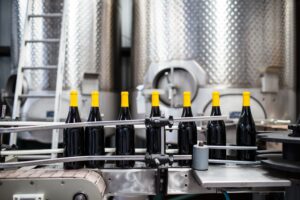
The Moon will give you a date. What it can’t give you is a clean fill, a consistent level, a sealed closure and a wine that arrives in the glass the way it left the tank.
At Il-Tec we build semi-automatic bottling and filling machines, corking and capping systems and wine filtration equipment for small and medium producers — including the counter-pressure fillers that sparkling wine demands. If you’d like help specifying a line for your winery, get in touch for a free consultation.
You may also like: How wine is made · How to store wine · Wine bottle names and sizes