
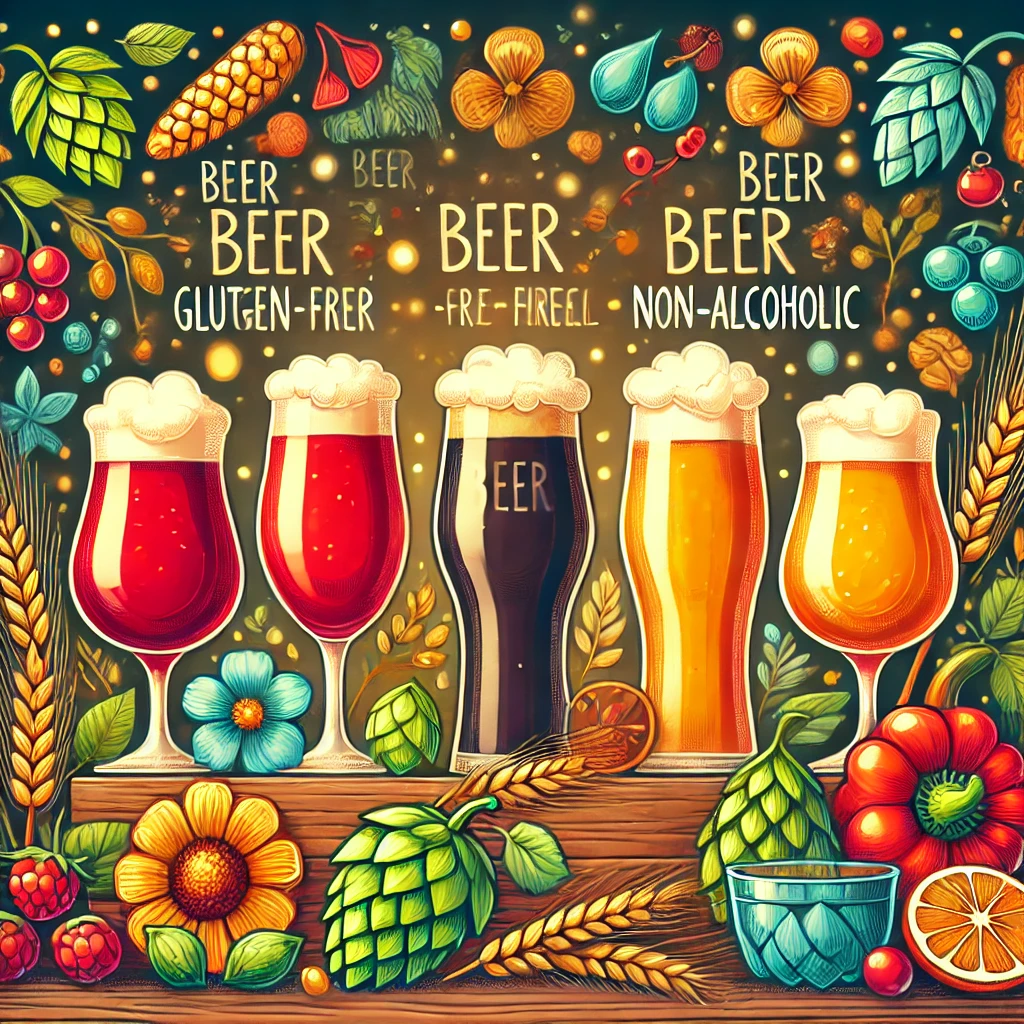
Beer is an alcoholic beverage with a millennia-old tradition, its basic production process popularised by European monks during the Middle Ages. Let’s take a brief look at how beer is made and the key ingredients involved in its production.
The primary ingredient in beer is water, which makes up approximately 90% of the final product. Barley is the second essential component. Once germinated, it becomes malted barley, the fundamental raw material. Hops are then added to provide the distinctive aroma and bitterness. Lastly, yeast is introduced, playing a crucial role in the fermentation process.
How beer is made
The general beer production cycle consists of six main stages:
- Malting: Barley is soaked in water to germinate, after which it becomes malted barley. The grains are then dried in kilns, giving them the specific roast that forms the basis of beer production.
- Milling: The malted grains are ground into a coarse flour.
- Mashing: The coarse flour is mixed with hot water and stirred to enable the starch to break down into sugars.
- Boiling: The wort is boiled to sterilise it and kill any bacteria. Hops are also added at this stage.
- Fermentation: After boiling, the wort is cooled and transferred to a fermentation vessel. Yeast is added, converting the sugars into alcohol and carbon dioxide.
- Maturation: Following fermentation, the beer is stored in a cool, dark place to mature and develop its flavour.
For industrial beer production, the matured beer undergoes filtration and pasteurisation to enhance its stability and purity before bottling.

Craft beer production
Craft beer is produced in small quantities by independent brewers, often using high-quality ingredients and small-scale processes in microbreweries. But how is craft beer made? Unlike industrial beer, which is mass-produced, craft beer tends to be richer in flavour and aroma, as it is neither microfiltered nor pasteurised.
The production process remains the same: malting, milling, mashing, boiling, fermentation, and maturation. What sets craft beer apart are the ingredients and methods used. Enthusiasts often experiment with unique fermentation techniques and ingredients to create new varieties of beer.
Some distinguishing factors include:
- Types of cereals: For instance, oats are often used in stout and darker beers.
- Flavour additions: Spices, herbs, fruits, and berries can be added. An example is Belgian cherry beer, known as Kriek.
- Yeast varieties: Different types of yeast create distinct flavours.
- Fermentation styles: High or low-temperature fermentation affects the outcome. For instance, Belgian Strong Ale, a high-fermentation beer, is noted for its complex and spicy flavour.
Gluten-free beer production
A common question is how gluten-free beer is made. The production stages are identical, but the ingredients used must be gluten-free. This involves malting cereals that do not contain gluten. Examples of such cereals include malted rice, maize, quinoa, sorghum, and amaranth, which replace traditional barley or wheat.
Common cereals used in gluten-free beer production include:
- Rye: Popular in Eastern European beers, rye imparts spicy notes and a robust flavour.
- Maize: Often used in lighter, more refreshing beers like American lagers.
- Rice: Found in Japanese beers, rice produces a delicate and light flavour.
Non-alcoholic beer production
Non-alcoholic beer is produced using the same process as regular beer, with one key difference: the alcohol is removed during fermentation.
The process begins by mixing water, malted barley, hops, and yeast in a brewing kettle. The mixture is heated to activate fermentation, during which the yeast converts sugars into alcohol and carbon dioxide. The alcohol is then removed through methods such as evaporation, reverse osmosis, or membrane filtration.
The beer is then pasteurised to ensure it remains fresh in bottles or cans, resulting in a product with an alcohol content below 0.5%.

Red beer production
The production process for red beer is similar to regular beer, but with one key distinction. The malting process involves using darker malts that are roasted for longer. This gives red beer its characteristic colour and imparts a unique flavour profile.
Double malt beer production
The term “double malt” does not refer to a specific type of beer but is used in Italy to classify beers with a higher sugar content (measured in Plato degrees) and alcohol content. Double malt beers have an alcohol content of over 3.5% and a Plato degree exceeding 15.
Despite the name, “double malt” beer does not contain twice the malt; the production process—malting, milling, mashing, boiling, fermentation, and maturation—is the same as for other beers.